
Luxembourg Procurement Law 2026: Rules, Thresholds & Portal

Luxembourg, a vital financial hub at the heart of Europe, presents a unique and often rewarding landscape for businesses looking to engage in public procurement. While its small size might suggest a simpler system, the Grand Duchy's public tendering process is deeply integrated with the broader European Union framework, ensuring transparency, fair competition, and adherence to international standards. For bid managers, export managers, and procurement officers worldwide, understanding the nuances of Luxembourg's procurement law in 2026 is essential for successful market entry and contract acquisition.
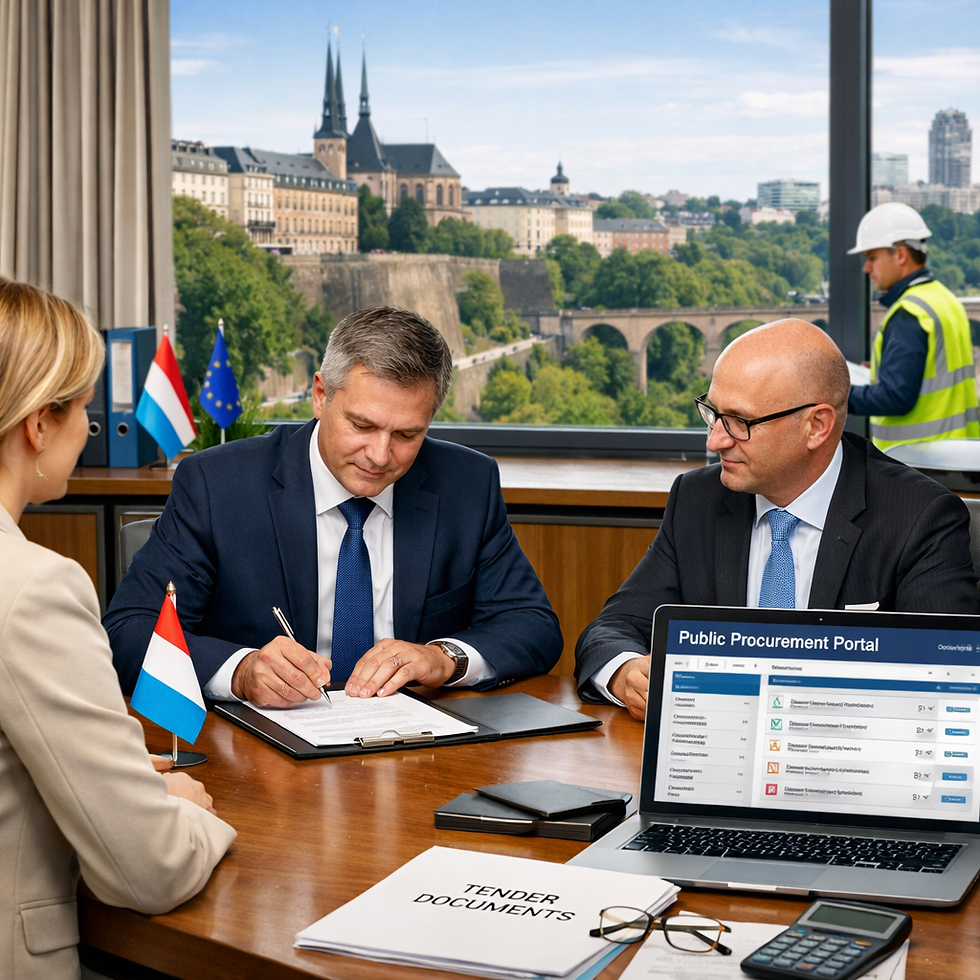
The system is not static; recent adjustments, particularly to national thresholds, mean that staying current with the regulations is paramount. This guide will walk through the core legal framework, current thresholds, bidding methods, and the practical steps for engaging with the Luxembourgish e-procurement portal, pmp.lu , highlighting key considerations for foreign bidders and the tools available to simplify the process.
Luxembourg Procurement Law 2026: The Legal Framework and Key Thresholds
Luxembourg’s public procurement system in 2026 continues to be firmly rooted in the Law of 8 April 2018 on public procurement and its implementing Grand-Ducal Regulation of 8 April 2018 . These foundational documents transpose the relevant EU directives into national law, creating a dual-layered structure where EU-level procedures follow European Commission thresholds and national procedures operate under Luxembourg-specific values. This dual system can initially seem complex, but it ensures alignment with broader European principles while allowing for national flexibility in smaller contracts.
The distinction between EU and national thresholds is crucial for determining the applicable bidding procedure. For contracts reaching the EU thresholds, Luxembourg faithfully applies the European Commission's values, which were updated for the 2026–2027 period. This means that for central government supplies and services, the threshold stands at EUR 140,000 . For sub-central entities procuring supplies and services, the threshold is EUR 216,000 . Works contracts and concessions, typically larger in scale, are subject to a higher threshold of EUR 5,404,000 . These figures are not merely administrative; they dictate whether a tender must be published across the EU and follow more stringent procedural rules.
Below these EU thresholds, Luxembourg’s national regulations come into play, offering a more nuanced approach tailored to smaller-scale procurement. For contracts up to EUR 55,000 , procurers are permitted to use a negotiated procedure without publication, streamlining the process for very small procurements. A slightly higher bracket, from EUR 55,000 to EUR 100,000 , also allows for a negotiated procedure without publication, provided at least three bidders are invited. This ensures a degree of competition even for these smaller contracts. For supplies and services exceeding EUR 100,000 , and for works above EUR 800,000 , the open procedure becomes mandatory unless specific exceptions under the directives allow for a negotiated procedure with or without publication. It's also important to note the recent change in Article 151 of the 2018 implementing regulation, which saw the threshold for "small tenders" awarded by restricted or negotiated procedure without publication increase from EUR 60,000 to EUR 79,000 excluding VAT , effective from the Grand-Ducal Regulation of 29 May 2024 . These national thresholds provide a clear roadmap for organizations considering tenders that might not reach the higher EU values.
Accepted Bidding Methods and Evaluation Criteria in Luxembourg
Luxembourg’s procurement system employs a range of bidding methods designed to match the complexity and value of the contract, all while adhering to the principles of transparency and non-discrimination. The choice of procedure is primarily dictated by the contract value and the nature of the goods, services, or works being procured.
Open Procedure: This is the most common and transparent method, mandatory for larger contracts (above EUR 100,000 for supplies/services and EUR 800,000 for works nationally, or at EU thresholds). Any interested economic operator can submit a tender.
Restricted Procedure without Publication: This method allows contracting authorities to invite a limited number of pre-selected candidates to submit bids. It is typically used for specific types of contracts or under certain conditions, including the "small tenders" under the recently updated threshold of EUR 79,000.
Negotiated Procedure without Publication: Permitted for very small contracts (up to EUR 55,000) or for slightly larger ones (EUR 55,000 to EUR 100,000) where at least three bidders are invited. This offers flexibility but requires careful documentation by the contracting authority.
Negotiated Procedure with Publication: Used where permitted by EU rules, typically for complex contracts or in situations where initial tenders were irregular or unacceptable.
Direct Award / Low-Value Award: For contracts below the smallest national thresholds, direct awards are possible, simplifying procurement for very minor needs.
Framework Agreements: Luxembourg, following EU practice, frequently uses framework agreements. These allow contracting authorities to establish terms and conditions for future contracts over a set period, offering efficiency for recurring needs.
When it comes to evaluating bids, Luxembourg adheres to the standard EU models, focusing on obtaining the best value for public money. The two primary evaluation criteria are:
Navigating the Luxembourg e-Procurement Portal (PMP): pmp.lu Registration and Submission Guide
The digital backbone of Luxembourg's public procurement system is the Portail des marchés publics (PMP) , accessible at pmp.lu . This platform is the central channel for the publication of tender notices and, crucially, for the electronic submission of bids for above-threshold contracts. For any company serious about doing business with the Luxembourgish public sector, mastering this portal is non-negotiable.
To participate in tenders requiring electronic submission, the first step is to register on the PMP portal. This usually involves creating an organizational profile, providing basic company information, and designating authorized users. While the exact steps might evolve, the general process typically includes: Accessing pmp.lu: Navigate to the official portal. Creating an Account: Look for options to register as an economic operator or supplier. You will need to provide company details, including legal name, address, VAT number, and contact information. User Management: Set up individual user accounts for team members who will be responsible for managing bids. Organization Profile: Complete your organization's profile, as this information can often be pre-filled in tender submissions, saving time. TendersGo also offers organization profiles and company information pages to help suppliers present their credentials effectively.
Once registered, you can monitor tenders relevant to your business. When you find a suitable opportunity, the submission process generally follows these steps: Download Tender Documents: All relevant documents, including the tender specifications, contract clauses, and annexes, will be available for download directly from the tender notice on PMP. Prepare the European Single Procurement Document (ESPD): The ESPD is a self-declaration that serves as preliminary evidence that you meet the exclusion and selection criteria. It is a standard EU requirement and is critical for Luxembourgish tenders. The PMP portal often provides tools or links to generate the ESPD. Prepare Technical and Financial Offers: Based on the tender specifications, meticulously prepare your technical proposal, outlining how you will meet the requirements, and your financial offer, detailing pricing. Ensure all sections are completed accurately and completely. Upload Documents: Electronically upload all required documents to the PMP portal before the specified deadline. Pay close attention to file formats and size limits. Electronic Signature (if required): Some tenders may require electronic signatures for submission. Ensure you have the necessary digital certificates if this is the case. Confirmation of Submission: The portal will typically provide a confirmation of your submission. Keep this record for your files.
It’s important to remember that deadlines are strict, and late submissions are almost universally rejected. Using a platform like TendersGo can help you stay on top of these deadlines with unlimited email alerts , ensuring you never miss an opportunity in Luxembourg or elsewhere.
Required Documents and Foreign Bidder Requirements for Public Tenders in Luxembourg
Participating in Luxembourgish public tenders, especially for foreign bidders, requires careful attention to documentation. While specific requirements vary by tender, a core set of documents and considerations are consistently encountered. As Luxembourg operates within the EU framework, the European Single Procurement Document (ESPD) plays a central role.
Key Documents for Submission:
European Single Procurement Document (ESPD): This is a self-declaration that acts as preliminary evidence that a bidder meets the qualification criteria and is not in an exclusion situation. It significantly reduces the administrative burden, as only the winning bidder typically needs to provide full evidential documents. For foreign bidders, understanding the ESPD and accurately completing it is critical.
Technical Offer: This document details how your company proposes to meet the technical specifications of the contract. It should demonstrate your capabilities, methodology, proposed team (if applicable), and any innovative solutions.
Financial Offer: This outlines the pricing for the goods, services, or works. It must adhere strictly to the format required by the tender, including breakdowns, unit prices, and overall costs.
Proof of Economic and Financial Standing: Depending on the tender, this might include annual accounts, balance sheets, or statements from banks demonstrating financial capacity.
Proof of Technical and Professional Capacity: This can involve lists of similar contracts performed in the past, academic and professional qualifications of key personnel, or details of technical equipment and facilities.
Certificates and Licenses: Any specific industry-related certifications, professional licenses, or quality management system certifications (e.g., ISO) required by the tender.
Legal Domicile and Representation: Foreign bidders may need to demonstrate their legal status in their home country and, for some contracts, potentially establish a local presence or legal representative in Luxembourg.
Considerations for Foreign Bidders:
Luxembourg’s adherence to EU procurement directives and the WTO Government Procurement Agreement (GPA) means that foreign bidders from signatory countries generally benefit from equal treatment and non-discrimination. This opens up significant opportunities for international companies. However, there are practical aspects to consider:
Language Requirements: While the official languages of Luxembourg are Luxembourgish, French, and German, tender documents might be published primarily in French or German. Occasionally, English might be used for international tenders. Foreign bidders should be prepared to translate documents or engage with linguistic support to ensure full comprehension and accurate submission.
Local Expertise: For complex projects, partnering with a local Luxembourgish entity can provide invaluable local market knowledge, cultural understanding, and logistical support.
Legal Compliance: Ensure full compliance with Luxembourgish and EU legal frameworks, including data protection (GDPR), labor laws, and tax regulations.
E-procurement Portal Usage: The PMP portal is central. Foreign companies must register and become proficient in its use for submission. Access to tools like TendersGo's advanced search and filtering can help identify relevant opportunities and manage the bid pipeline efficiently.
While bid security or tender guarantees are common in public procurement, the research did not verify a universal Luxembourg-wide percentage. Requirements for such guarantees will be specified within each individual tender document, so always check the specific tender for details.
Recent Public Procurement Reforms and International Agreements
Public procurement is a dynamic field, and Luxembourg, like other EU member states, continuously adapts its framework. The Grand Duchy’s system is not only shaped by national legislation but also by ongoing developments at the European level and international agreements.
Key Developments and Reforms (2024-2026):
Grand-Ducal Regulation of 29 May 2024: This regulation significantly increased the threshold in Article 151 of the 2018 implementing regulation from EUR 60,000 to EUR 79,000 excluding VAT. This change affects works, supplies, and services that can be awarded by restricted procedure without publication or negotiated procedure, providing greater flexibility for smaller, national-level contracts.
EU Threshold Updates (2026–2027): The European Commission regularly updates the thresholds for EU-level procurement. The current values for 2026–2027 are EUR 140,000 (central government supplies/services), EUR 216,000 (sub-central supplies/services), and EUR 5,404,000 (works/concessions). These updates are critical as they determine whether a contract falls under the more extensive EU publication and procedural rules.
Continued Alignment with EU Directives: Luxembourg's procurement framework remains robustly aligned with the EU directives, particularly the 2014 package. This commitment ensures consistency across the single market and reinforces principles of transparency, equal treatment, and non-discrimination. Discussions at the EU level, such as the potential shift towards the "best price-quality ratio" as a default award method, influence future directions, even if not yet fully codified in Luxembourgish national law for 2026.
International Agreements:
Luxembourg's procurement landscape is significantly influenced by two major international frameworks:
EU Procurement Directives: As a member of the European Union, Luxembourg is bound by the EU's comprehensive procurement directives. These directives mandate open and fair competition for contracts above certain thresholds, ensuring that companies from across the EU can compete on an equal footing. This is a fundamental aspect that benefits all EU-based companies, and by extension, companies from countries with trade agreements with the EU that include procurement clauses.
WTO Government Procurement Agreement (GPA): Luxembourg, through its EU membership, is also a signatory to the WTO GPA. This multilateral agreement opens up government procurement markets among its parties, promoting transparency and non-discrimination. For foreign bidders from GPA signatory countries, this means enhanced access to Luxembourgish public tenders, particularly those above the GPA-aligned EU thresholds. The GPA reinforces the principles of national treatment and non-discrimination, ensuring that foreign suppliers are treated no less favorably than domestic suppliers.
These international agreements and ongoing reforms underscore the importance of continuous monitoring of the regulatory environment. Utilizing resources like TendersGo's AI assistance can help businesses stay informed about these changes and their implications for bidding strategies.
How to Bid on Luxembourg Government Tenders Step by Step
Successfully navigating the Luxembourgish public procurement process requires a methodical approach. Here's a practical, step-by-step guide for companies looking to secure government contracts: Identify Relevant Tenders: The first step is to actively search for opportunities. The primary source for Luxembourgish tenders is the PMP portal (pmp.lu) . However, for a broader reach and to leverage advanced search capabilities across 220+ countries and 145 languages, platforms like TendersGo offer a significant advantage. You can set up saved searches and unlimited email alerts on TendersGo to receive notifications for tenders matching your specific criteria, ensuring you don't miss any opportunities in Luxembourg or neighboring markets. Determine Thresholds and Procedure Type: Once a tender is identified, verify its estimated value. This will immediately tell you whether it falls under national Luxembourgish thresholds or the higher EU thresholds. This distinction dictates the applicable legal framework and the type of bidding procedure (open, restricted, negotiated) to expect. Register on PMP.lu: If you haven't already, register your company on the Portail des marchés publics (pmp.lu). This is essential for accessing full tender documents and, crucially, for submitting your bid electronically. Ensure your company profile is complete and up-to-date. Download and Review Tender Documents Thoroughly: Access all tender specifications, contract terms, technical requirements, and annexes from the PMP portal. Pay close attention to eligibility criteria, deadlines, required documents, and any specific forms or templates. This is where a PDF document viewer can be invaluable for detailed analysis. Prepare the European Single Procurement Document (ESPD): Complete the ESPD, which is a self-declaration of your company's eligibility. Ensure all sections are accurately filled out, as this is a fundamental requirement for most EU-aligned tenders. Develop Your Technical and Financial Offers: Craft a compelling technical proposal that clearly addresses all specifications and demonstrates your capabilities. Simultaneously, prepare a detailed financial offer, ensuring it adheres to the requested format and pricing structure. Be mindful of the evaluation criteria – whether it's lowest price or best price-quality ratio (MEAT). Gather Supporting Documentation: Collect all other required documents, such as proof of financial standing, professional qualifications, certifications, and past project references. Ensure all documents are translated if necessary and certified if required. Understanding CPV/NAICS/UNSPSC classification can also help in categorizing your services and aligning with tender requirements. Submit Your Bid Electronically: Upload all prepared documents to the PMP portal well in advance of the deadline. Double-check that all files are correctly uploaded and that the submission is confirmed by the system. Avoid last-minute submissions to prevent technical glitches. Follow Up and Await Notification: After submission, monitor the portal for any communications or clarifications from the contracting authority. If your bid is unsuccessful, analyze the feedback provided (if any) to refine your approach for future opportunities.
How TendersGo Helps You Find and Win Luxembourgish Tenders
For businesses looking to penetrate the Luxembourgish public procurement market, a comprehensive and intuitive tool can make all the difference. TendersGo is designed to streamline the entire tender discovery and management process, offering a suite of features that directly address the challenges of international procurement.
Firstly, TendersGo provides access to the world's largest tender search engine, encompassing opportunities from Luxembourg and over 220 countries. This means you won't just be looking at the PMP portal; you'll have a much broader view of potential contracts, often aggregated and translated into 145 languages. Our advanced search and filtering capabilities allow you to pinpoint specific tenders in Luxembourg by sector, value, keywords, and even CPV/NAICS/UNSPSC codes, ensuring you find the most relevant opportunities without sifting through irrelevant noise.
Once you’ve identified promising tenders, TendersGo enhances your ability to analyze them. Our AI-powered summaries distill complex tender documents into easily digestible insights, saving valuable time and highlighting key requirements and deadlines. This is especially useful for tenders published in French or German, providing a quick overview to decide if a full translation is warranted. Furthermore, our integrated PDF document viewer allows you to access and review tender specifications directly within the platform, keeping all your research centralized.
Staying organized and meeting strict deadlines is paramount in procurement. With TendersGo, you can set up unlimited email alerts for Luxembourgish tenders that match your criteria, ensuring you’re notified the moment a relevant opportunity is published. You can also save searches, building a personalized pipeline of potential contracts. For foreign bidders, our platform’s ability to handle multiple languages and integrate global tender data helps overcome geographical and linguistic barriers, providing a level playing field.
Finally, TendersGo acts as more than just a search engine; it's a global B2B marketplace where companies can showcase their capabilities and connect with potential partners. By leveraging our organization profiles and company information pages, you can present a professional image to contracting authorities and potential collaborators, enhancing your chances of success in the competitive Luxembourgish procurement landscape. The journey into international public procurement can be complex, but with the right tools, it becomes a clear path to new business opportunities.





